COMMUNICATION Problems
What do you consider to be the main communication problem in your job?
This is the question I have asked managers in many countries. Their answers have all been very similar.
What are your main communication problems and what can you do about them?
Here is a handful of problems you may be able to do something about
* Too many messages
“I am sent too many messages I don’t need to see – but often do not get the information I need or I get it too late.”
It’s important to know which information needs to be shared and when and where it needs to go.
By mixing work, personal communications and junk mail together it distracts from professionalism at work and becomes a time-waster. These need to be separated and dealt with accordingly.
* Poorly written communications and poor instructions
Today we tend to have a diverse and global workforce therefore all messages should be written in basic English.
Try to use the simplest words to convey the right message – don’t clutter your messages with surplus or large words that some people may not understand.
* Experts take things for granted
” Many technical messages written by professionals needs simplification to be understood and fully appreciated.”
“People’s interests become so real and important to them that they take too much for granted, especially dealing with other people.”
People leaders need to stress the importance of listening, questioning and simple clear communication.
* Confused area of responsibility
“Trying to coordinate the problems of different teams and organisations can cause communication problems. They often become problems only because of the confusing areas of responsibility.”
Make sure all teams have clear instructions both verbally and in writing so they can often refer back to them. If changes are made make sure all people have been informed as soon as possible.
* Check it before you send it
Edit all your work to make sure your message is correct and clear. A little time spent checking can save much anguish and miss-communication.
Don’t send off angry messages – a good rule is to delay your message until you have had a night’s sleep.
Because of work pressures often a message is sent using the wrong channel.
It’s quick and easy to send off an e-mail when we should have talked to a person.
Face to face is still the best way to explain a confusing situation.
What can we do about these communication problems? No, what can YOU do about them? It’s your responsibility now you are a people leader.
Geoffrey Moss (mossassociates.co.nz)
“You will please more people by listening to them than by talking to them.”
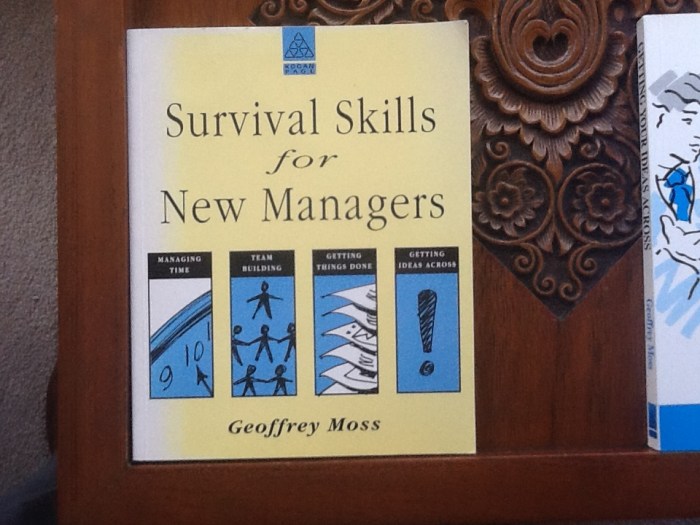
Source: “Survival Skills for New Managers” first published in New Zealand and in England by Kogan Page, in China by Yale Management, in Singapore by the Singapore Institute of Management, in Australia by CCH, and in South Africa by Francolin Publishers.
 Another Handful of Tips